
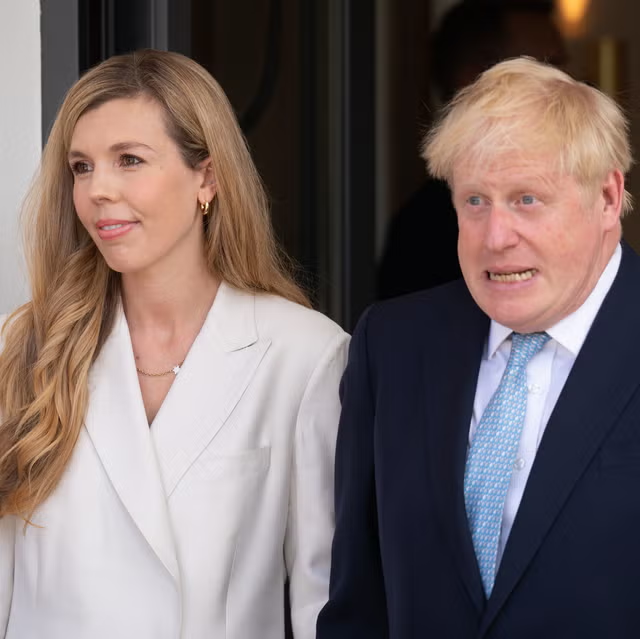
When Boris Johnson wife news surfaces, it’s rarely limited to personal updates—it becomes a proxy for evaluating his broader judgment, stability, and the gap between his public persona and private decisions. The former British Prime Minister’s marriage to Carrie Johnson represents his third attempt at matrimony, and each development in their relationship gets scrutinized not as celebrity gossip but as evidence relevant to his political credibility and leadership capacity.
The couple welcomed their fourth child together, Poppy Eliza Josephine Johnson, in recent months, while Johnson navigates post-premiership life. But the attention surrounding his marriage isn’t driven by typical celebrity interest—it’s rooted in the fact that his personal decisions have repeatedly intersected with his professional responsibilities in ways that created political vulnerabilities and ethical questions.
The Mechanics Of Stealth Ceremonies And Media Manipulation
Johnson and Carrie Symonds married in an unexpectedly secretive ceremony at Westminster Cathedral, London’s main Roman Catholic cathedral, catching media and political observers off guard. Just a week earlier, the couple had reportedly distributed save-the-date notifications for a wedding planned for the following summer, making the actual ceremony a deliberate misdirection.
From a media management standpoint, this approach reveals a sophisticated understanding of attention cycles. By announcing a future date, they satisfied the market’s need for information while maintaining operational control over the actual event. When the real ceremony occurred, it was too late for extensive media presence or public scrutiny.
Look, the bottom line is that surprise announcements work best when the figure involved has something to gain from bypassing traditional coverage. In Johnson’s case, avoiding a heavily photographed, publicly analyzed wedding reduced opportunities for protesters, critics, and journalists to frame the event through a political lens. A prime minister’s office confirmed the marriage after it had already occurred, shifting the story from “should this happen” to “this has happened”.
That’s not romantic spontaneity. That’s tactical information control executed when the subject knew traditional wedding coverage would invite uncomfortable questions about timing, priorities, and his history of marital instability.
Relationship Timing And Political Risk Assessment
When Johnson moved into 10 Downing Street with Symonds before finalizing his divorce from his second wife, Marina Wheeler, it created a visible departure from conventional expectations about how prime ministers manage personal transitions. Symonds welcomed their son Wilfred shortly after Johnson’s severe episode with Covid-19, compressing major personal and health crises into an extraordinarily narrow timeframe.
What I’ve learned is that when personal timelines overlap with professional responsibilities in high-stakes roles, every decision gets evaluated through a risk management lens. Johnson’s supporters framed his relationship with Carrie as evidence of personal renewal. His critics viewed the same timeline as proof of impulsive judgment and disregard for optics.
The reality is both interpretations coexist in public perception, and that ambiguity creates ongoing vulnerability. Every new development in their marriage—births, renovations, public appearances—gets filtered through preexisting narratives about Johnson’s character and reliability. The relationship itself becomes evidence in a larger debate about fitness for leadership.
Influence Networks And The Renovation Controversy
Carrie Johnson faced significant criticism regarding her involvement in a costly renovation of the Downing Street official residence, initially funded by a Conservative Party donor. This incident crystallized concerns about influence, access, and the blurred boundaries between Johnson’s personal life and his public role.
From a practical standpoint, the controversy wasn’t primarily about decorating choices. It was about financial arrangements, transparency, and the perception that personal relationships were creating pathways for donor influence that bypassed standard accountability mechanisms. The fact that Carrie became a focal point of criticism reflects how partners of political figures inherit reputational risks when their proximity to power appears to grant them informal authority.
Here’s what actually matters: in political contexts, the spouse of a leader isn’t just a private individual—they’re a potential liability or asset depending on how their activities align with or contradict the leader’s public commitments. When Carrie’s involvement in policy discussions and personnel decisions became subjects of media coverage, it raised questions Johnson couldn’t easily dismiss because they touched on fundamental governance principles about who wields power and on what basis.
Family Expansion And Narrative Rehabilitation Strategies
The arrival of Poppy Eliza Josephine Johnson, the couple’s fourth child together, was announced through an Instagram post featuring Johnson holding his daughter, with Carrie describing the family as “totally smitten”. The carefully curated announcement reflects standard practice for public figures managing personal news—controlling the initial framing before media outlets construct their own narratives.
Johnson also has four children with his ex-wife Marina Wheeler, plus a child born from an affair with art consultant Helen Macintyre, bringing his total number of children to a figure that remains somewhat ambiguous due to his historical reluctance to discuss his private life comprehensively.
The 80/20 rule applies here in a specific way: while 80% of public figures benefit from being perceived as stable family people, Johnson’s unusually complex family structure creates 80% more surface area for criticism about consistency between personal behavior and public statements. Every new child becomes both a humanizing detail and a reminder of previous relationship breakdowns.
Reputational Recovery And The Marriage Premium Effect
Johnson’s marriage to Carrie represents his third attempt at matrimony, while it’s Carrie’s first. That asymmetry matters because it shapes how audiences evaluate commitment and stability. For Carrie, the marriage represents a major life decision made in full view of Johnson’s track record. For Johnson, it’s the latest iteration in a pattern of serial monogamy that critics interpret as evidence of personal instability.
What I’ve seen work in reputation rehabilitation is sustained, consistent evidence that contradicts negative narratives. Johnson’s challenge is that every Boris Johnson wife news cycle contains embedded reminders of his previous marriages, creating a structural problem where positive personal developments can’t exist independently from past relationship failures.
The data tells us that political figures with complicated personal lives can successfully pivot to new chapters, but they rarely escape having those complications resurface whenever their current relationships become news. Johnson’s post-premiership visibility means every family announcement, every public appearance with Carrie, every new child becomes an opportunity for media outlets to contextualize the present through the lens of his past.
From a strategic standpoint, the best approach in this situation is boring consistency—allowing enough time to pass that the current relationship establishes its own track record separate from previous patterns. But that requires staying out of controversy, which has never been Johnson’s strength. As long as he remains a polarizing public figure, his marriage will continue to be analyzed not as a personal matter but as evidence in ongoing debates about his judgment and character.
