
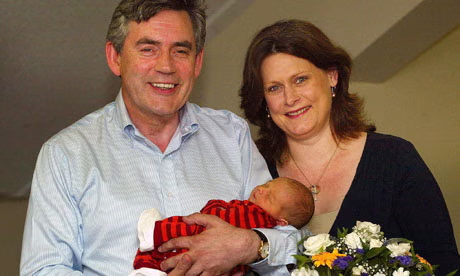
When public figures face personal tragedy alongside parenting triumphs, the narrative machinery often reduces complex family realities to simplified headlines. Gordon Brown children news demonstrates how former political leaders navigate the tension between protective privacy and unavoidable public scrutiny, particularly when medical disclosures and charitable work intersect with their family’s story.
The former Prime Minister and his wife Sarah have two sons, while also carrying the memory of a daughter who died shortly after birth. What makes their situation noteworthy from a media-cycle perspective is how personal loss transformed into institutional action, creating a feedback loop where private grief became public advocacy, which then generated ongoing attention to their family structure.
The Signals Behind Privacy Erosion And Media Timing
Look, the bottom line is that privacy boundaries dissolve predictably when health information intersects with public interest. When Fraser Brown was diagnosed with cystic fibrosis as an infant, the disclosure didn’t emerge through official channels but through press investigation and subsequent negotiation.
The mechanics here reveal how confirmation pressure operates in real time. News organizations obtained medical information, approached the family’s representatives, and facilitated a managed disclosure that included supportive quotes from colleagues. This wasn’t speculation or rumor management—it was the reality of how private medical facts become public narratives when protective barriers fail.
What I’ve seen consistently is that once a disclosure occurs, the family narrative gets periodically revisited whenever the public figure re-enters media cycles. The former Prime Minister later acknowledged the publication left him devastated, demonstrating the lasting tension between what gets revealed and how families actually experience that exposure.
Tragedy, Institutional Response, And Narrative Transformation Strategy
When the Browns lost their daughter Jennifer days after her premature birth, the public response was immediate and sympathetic. From a reputational standpoint, this created an unusual dynamic where personal tragedy became intertwined with public identity in ways that most private citizens never experience.
The couple’s decision to establish a charity—initially called PiggyBankKids and later rebranded as TheirWorld—represents a strategic transformation of grief into institutional purpose. This isn’t about dismissing genuine charitable intent; it’s about recognizing how such actions create ongoing narrative threads that keep family stories in circulation.
The research center they funded directly contributed to medical advances that saved other premature infants, including the grandchild of another prominent political figure. This creates what business analysts would call a “mission validation loop”—evidence that justifies continued attention and demonstrates tangible impact beyond symbolic gestures.
Public Confirmation Cycles And The Disclosure Pressure Reality
Here’s what actually works when managing health disclosure: acknowledging that resistance has natural limits when information already exists in reportable form. The Browns issued statements describing Fraser as fit and healthy while confirming the diagnosis, framing the news within an optimistic medical context.
The data tells us that families in public positions face asymmetric information dynamics. Journalists can access medical records, speak with hospital staff, and piece together health situations before families are ready to discuss them publicly. The 80/20 rule applies here, but inverted—even if you control 80% of your privacy, the remaining 20% of vulnerabilities can generate 100% of the headlines.
From a practical standpoint, the family’s approach combined confirmation with context control. They emphasized medical optimism, referenced Fraser’s healthy development, and attempted to prevent the story from being framed as tragedy. Whether this succeeded depends entirely on how individual audiences interpreted the coverage.
Family Structure As Ongoing Media Commodity And Attention Economics
The reality is that prominent families become periodically interesting to audiences regardless of newsworthiness thresholds. Sarah Brown’s interviews about Jennifer’s death, conducted long after the loss, demonstrate how media outlets revisit family narratives when broader contexts emerge—in this case, discussions about premature birth research and infant mortality.
I’ve learned that family size, health conditions, and charitable connections all function as content anchors that journalists return to when covering the public figure for any reason. The Browns’ two sons are now adults, yet searches for information about the family still surface historical details about diagnoses, losses, and advocacy work.
This isn’t criticism of coverage; it’s acknowledgment of how information persistence works in digital environments. Once details enter public record, they become permanent reference points in any profile or retrospective piece about the individual.
The Economic Reality Of Charitable Work And Continued Visibility Cycles
What’s interesting from a strategic standpoint is how charitable foundations create legitimate reasons for ongoing family visibility. When the Browns’ research center contributed to saving Ella—a premature infant with direct connections to another political family—the story generated coverage that naturally revisited Jennifer’s death and the family’s structure.
This represents a complicated tradeoff that families navigate constantly. The charitable work delivers genuine medical value and honors lost children, but it also ensures that personal tragedy remains part of public discourse indefinitely. The Catherine Crawley case, where Ella’s grandmother wrote to thank the Browns, exemplifies how these narratives expand through connection and grateful acknowledgment.
From a practical business perspective, this is reputation management through mission-driven activity. The family transforms ongoing attention from something purely invasive into something partially purposeful, though the emotional cost of repeatedly discussing loss remains significant. Sarah Brown’s acknowledgment that the loss remains deep while celebrating their sons captures this ongoing tension perfectly.