
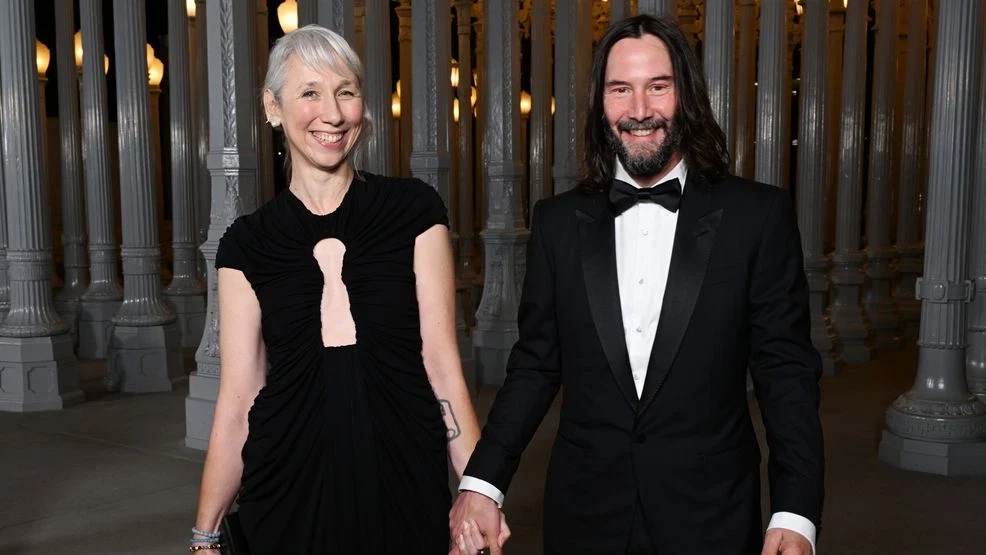
The persistence of Keanu Reeves wife news demonstrates how misinformation markets operate when there’s sustained audience demand for a narrative that doesn’t match reality. Reeves is not married, has never been married, and his longtime partner Alexandra Grant has had to publicly debunk AI-generated wedding photos and false reports multiple times. Yet the rumors keep regenerating, revealing something significant about celebrity coverage, audience projection, and why certain figures attract speculative narratives regardless of factual accuracy.
The actor’s relationship with Grant, which became public knowledge when they attended the LACMA Art + Film Gala together, represents a relatively rare example of a high-profile partnership that operates outside traditional publicity frameworks. But that restraint hasn’t prevented—and may have actually fueled—the repeated circulation of false marriage claims that both Reeves and Grant have been forced to address.
Why False Narratives Persist Despite Repeated Corrections
AI-generated images showing Reeves and Grant in fabricated wedding scenarios circulated widely on social media, accompanied by claims from unnamed “insiders” reporting they had married in Europe during the summer. A representative for Reeves quickly issued a statement confirming “it is not true. They are not married,” but the denial did little to slow the spread of the false information.
Grant addressed the situation directly on Instagram, posting an authentic photo of herself and Reeves kissing at James Turrell’s Roden Crater, writing: “This is a real photo. Not an engagement photo or an AI wedding announcement… simply a kiss!”. Her caption included a warning to “be careful out there,” acknowledging the challenge of correcting misinformation once it achieves circulation velocity.
From a practical standpoint, what’s happening here is a market failure in information verification. The audience demand for a Keanu Reeves marriage story is strong enough that low-quality supply—AI fabrications, anonymous “insider” claims, speculative gossip—fills the void even though authoritative sources have repeatedly stated it’s false. Look, the bottom line is that corrections rarely travel as far as the original false claims because they lack the emotional satisfaction audiences are seeking.
Audience Psychology And The Marriage Projection Problem
Reeves himself addressed the recurring rumors at the New York City premiere of his film Good Fortune, telling reporters: “Well, that wasn’t the first time. We’ve been going out for a long time”. His response acknowledges that marriage speculation has become a predictable pattern rather than an isolated incident.
What I’ve learned from watching these cycles is that certain public figures become repositories for audience fantasies about stability, commitment, and idealized relationships. Reeves has cultivated—or at least not actively contradicted—a public image as thoughtful, grounded, and emotionally available. That perception creates audience investment in seeing him achieve traditional relationship milestones, regardless of whether those milestones align with his actual priorities.
The reality is that Reeves and Grant appear to have a functional, committed partnership that simply doesn’t include marriage as a component. They travel together, support each other’s work, and have maintained their relationship for years. But for a significant portion of the public, an unmarried long-term relationship registers as incomplete or temporary, creating persistent pressure to retrofit their actual relationship into a more traditional narrative structure.
Platform Dynamics And How AI Amplifies Misinformation Velocity
The use of AI-generated imagery to fabricate wedding photos represents a concerning evolution in celebrity misinformation. Traditional false rumors required written claims that could be more easily identified as speculation. AI-generated images create visual “evidence” that appears authoritative even when completely fabricated, dramatically lowering the threshold for belief.
Here’s what actually matters: the cost of creating convincing fake content has dropped to near zero, while the cognitive effort required to verify authenticity remains high. That asymmetry favors misinformation because audiences encountering a realistic-looking wedding photo are more likely to accept it at face value than to investigate its origins.
Reeves praised Grant’s handling of the situation, telling reporters she “did a wonderful job” setting the record straight and noting that while people sent “nice messages and stuff,” Grant’s response appropriately clarified “here’s the reality”. What’s significant about his response is the acknowledgment that corrections require active effort—they don’t happen automatically just because something is false.
Strategic Silence And The Costs Of Privacy In High-Visibility Relationships
Reeves and Grant have been notably private about their relationship, offering only occasional public glimpses despite sustained media and audience interest. This approach has clear benefits—it protects their personal life from becoming constant content fodder—but it also creates an information vacuum that speculative narratives rush to fill.
From a risk management standpoint, there’s no perfect solution. Sharing more details about their relationship would satisfy some audience curiosity but would also establish new baseline expectations for access and disclosure. Maintaining privacy preserves boundaries but ensures that speculation and fabrication will continue because the market demand remains unsatisfied.
A source close to the couple described their relationship as “the most fun and positive relationship that Keanu has ever been in,” noting that Grant “is adorable, sweet, caring and funny” and has “her own life and career but is also very supportive of Keanu’s”. These carefully managed disclosures provide just enough information to counter purely speculative narratives without opening up their private life to comprehensive coverage.
Repetition Cycles And Why Corrections Fail To Stick
The fact that marriage rumors about Reeves and Grant have surfaced multiple times, each requiring separate denials, reveals a fundamental problem with how information ecosystems handle corrections. Each new wave of speculation attracts audiences who missed previous corrections, and platforms have limited mechanisms for attaching context to recurring false claims.
What I’ve seen work in similar situations is sustained, boring consistency that eventually makes the false narrative less interesting than the truth. Reeves and Grant celebrating another anniversary, another project together, another year of their unchanged relationship status gradually builds a factual record that contradicts the speculation. But that process takes years and depends on audiences eventually losing interest in the false version of events.
The 80/20 rule applies here in a frustrating way: roughly 80% of people who encounter false marriage claims will never see the corrections, meaning the misinformation becomes the dominant public perception regardless of its accuracy. Managing that reality requires accepting that you can’t fully control your public narrative—you can only provide authoritative information and hope it eventually reaches critical mass.
Reeves noted that the wedding rumors prompted “a lot of nice messages,” framing the speculation as well-intentioned even though it’s factually wrong. That’s diplomatic messaging, but it also reflects a pragmatic understanding that fighting every false claim creates more attention cycles than simply allowing the truth to persist alongside the fiction. The challenge is that this approach works better for the public figure than for the broader information environment, where false claims accumulating without consequence erode baseline trust in all celebrity reporting.